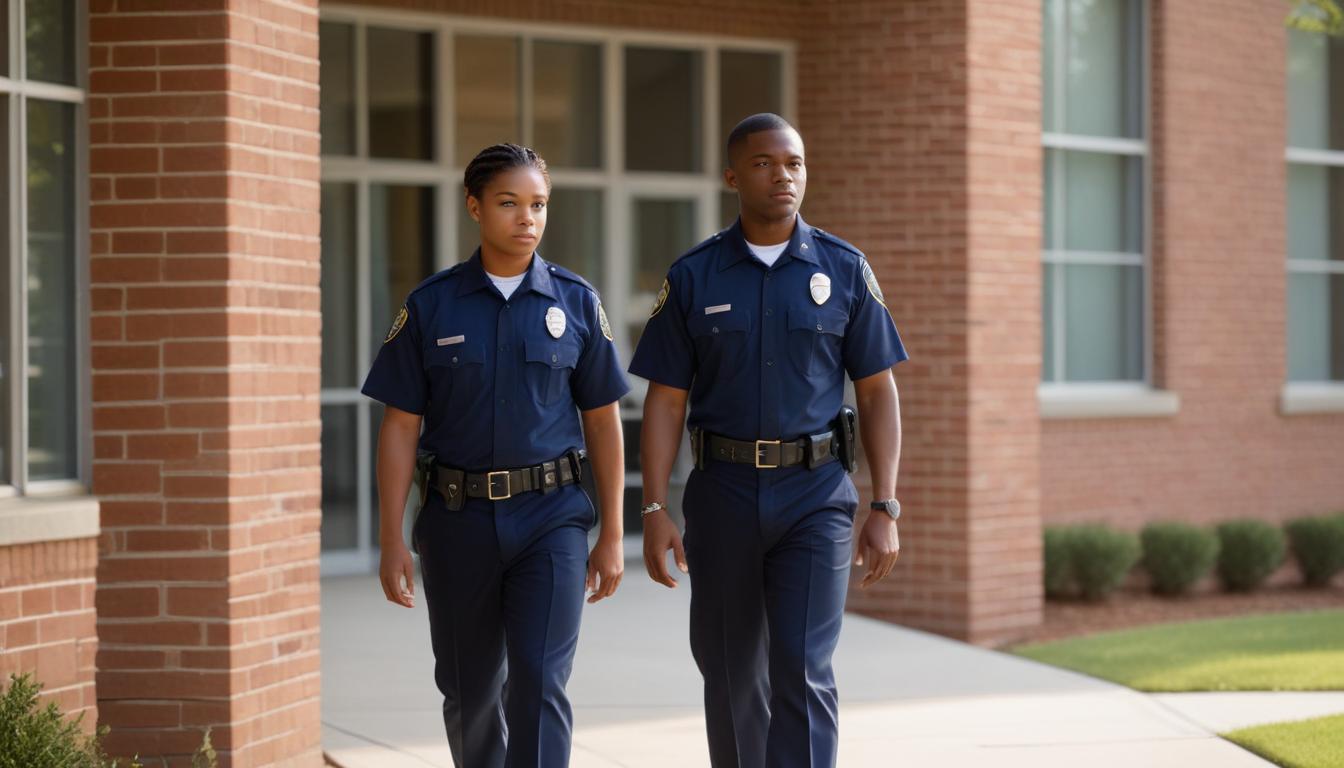
School and campus security services are specialized personnel and technology deployments that protect students, staff, and visitors at K-12 schools, colleges, and universities — covering access control, visitor management, incident response, emergency preparedness, and sometimes law enforcement functions. The right model depends on the type of institution: elementary schools typically use unarmed guards and visitor management systems, high schools often combine armed School Resource Officers with unarmed staff, and universities operate dedicated campus police departments. This guide covers what actually works, what doesn’t, and how administrators and superintendents should budget for school safety in 2026.
After three decades of data, one pattern is clear: most school security spending goes to the wrong things. Districts buy expensive metal detectors that rarely catch anything, then underfund the visitor management systems that catch registered sex offenders weekly. They hire armed guards without training requirements, then cut the counselor budget that prevents threats from escalating in the first place.
This guide is written for superintendents, principals, business officers, university risk managers, and HOA boards running private K-12 schools. The goal isn’t to sell fear — it’s to help you make the right tradeoffs between budget, safety, and a healthy learning environment.
What School & Campus Security Services Cover
School security is far more than a guard at the door. A complete program handles all of the following:
| Function | K-12 | University |
|---|---|---|
| Entry screening | Single main entrance, visitor check-in, ID scan | Card access at dorms and academic buildings |
| Visitor management | Photo ID, sex offender check, custody verification | Campus badge system, guest logs for residences |
| Access control | Locked exterior doors during class | Card-keyed buildings, time-based access zones |
| Patrols | Roving hallway and perimeter checks | 24/7 campus-wide foot and vehicle patrols |
| Emergency response | Active shooter, fire, medical, weather | Same plus mental health crises, large gatherings |
| Incident reporting | Fights, bullying, contraband, custody issues | Theft, sexual assault, alcohol violations, DUIs |
| Event coverage | Games, concerts, parent nights, graduation | Sporting events, campus protests, concerts |
| Threat assessment | Behavioral threat assessment teams | Threat assessment + Clery-compliant annual reports |
| Law enforcement liaison | Work with local PD, SRO program | Own sworn campus police (many universities) |
| Mental health response | Counselor coordination | Crisis counselors, psychiatric response teams |
A well-run program blends all of these — physical security alone without behavioral threat assessment and mental health resources is proven to be less effective than an integrated approach.
School Security Models
There are four common staffing models. Most districts blend two or more.
Model 1: School Resource Officer (SRO) Only
An SRO is a sworn law enforcement officer from the local police or sheriff’s department, assigned to a school under a Memorandum of Understanding (MOU). SROs carry firearms, have arrest authority, and spend full shifts at the school.
Best for: Large high schools (1,500+ students), schools with documented violent incidents, districts with strong community policing relationships.
Cost: $75,000-$130,000/year per officer (fully loaded with benefits and vehicle). The district typically shares cost with the police department.
Tradeoffs: Strong emergency response and deterrence capability. But studies (including a 2022 JAMA Network Open analysis) have not found SROs reliably reduce gun violence, while SRO presence has been linked to higher student arrest rates for non-criminal school behavior — especially among Black and disabled students. Districts using SROs should require specialized training (NASRO certification), clear scope-of-work MOUs, and ongoing oversight.
Model 2: Private Unarmed Security
Contracted guards from a private security company handle visitor check-in, hallway patrols, parking lot coverage, and incident response.
Best for: Elementary and middle schools, smaller high schools, private schools, after-school events.
Cost: $20-$32/hour unarmed ($42,000-$68,000/year per FTE). Most private guards work hourly and can flex to event coverage.
Tradeoffs: Cost-effective, less intimidating to students and parents, and focused on de-escalation rather than enforcement. But private guards have no arrest authority, can’t carry weapons in most K-12 contexts, and rely on calling 911 for serious incidents. Quality varies dramatically by company — hire from vendors with education-specific training programs.
Model 3: Private Armed Security
Some districts — particularly in states where SROs are unavailable or unaffordable — contract armed private guards.
Best for: High schools in areas with long police response times, districts without SRO partnerships.
Cost: $32-$50/hour per guard.
Tradeoffs: Fills the armed-response gap at lower cost than SROs, but with significant liability risk. Training requirements for armed private guards vary by state and are often weaker than law enforcement standards. Insurance premiums for districts using armed private guards are 2-4x higher than unarmed models. Most insurers require armed guards to have 40+ hours of firearms training plus annual requalification.
Model 4: Hybrid (SRO + Private Guards + Tech)
The most common modern K-12 model: one SRO at each high school for emergency response and criminal incidents, unarmed private guards at middle and elementary schools, and technology (visitor management, access control, video surveillance) across all sites.
Best for: Medium to large districts (5,000+ students) with the budget to support multiple layers.
Cost: $300,000-$1.5M/year district-wide depending on size.
Tradeoffs: Highest total cost but most resilient. Layered defense (people + technology + procedures) outperforms any single model.
Model 5: Campus Police Department (Universities Only)
Most major universities operate their own sworn police departments with arrest authority, 24/7 patrol, and full investigative capability.
Cost: $2M-$20M+ annually depending on enrollment and city vs rural location.
Tradeoffs: Full law enforcement capability on campus. But requires extensive oversight (civilian review boards, Clery compliance, Title IX coordination). Student activist movements have increasingly called for reform or reduction of campus police in favor of unarmed safety officers and mental health responders for non-criminal calls.
K-12 Security Priorities by Grade Level
Not every school needs the same setup. The threat profile and appropriate response change with age.
Elementary Schools (K-5)
Primary risks: Non-custodial parent abduction, unauthorized visitors, active shooter scenarios, allergy/medical emergencies.
Recommended setup:
- Single secure entry vestibule with buzz-in
- Visitor management system with sex offender and custody database checks
- 1 unarmed guard during arrival/dismissal + roving patrol during school day
- Locked exterior doors during class (all except main)
- PA system with classroom-level intercom
- Annual staff training on SRP/ALICE (no live drills for young children — tabletop only)
Budget: $40,000-$75,000/year per school.
Middle Schools (6-8)
Primary risks: Fights, bullying, weapons (typically knives, vapes, fireworks — rarely firearms), social media-based threats.
Recommended setup:
- Secure vestibule + visitor management
- 1-2 unarmed guards during school hours
- Cafeteria and hallway coverage during passing periods
- Random backpack checks per district policy (with ACLU guidance to avoid overreach)
- Digital incident reporting tied to student discipline records
- Behavioral threat assessment team (counselor + admin + SRO liaison)
Budget: $75,000-$150,000/year per school.
High Schools (9-12)
Primary risks: Fights, drug and vape possession, dating violence, off-campus beef carried into school, firearm incidents (rare but high consequence).
Recommended setup:
- Secure vestibule + visitor management
- 1 SRO + 1-3 unarmed guards depending on enrollment
- Parking lot coverage during arrival/dismissal + lunch
- Weapons detection at events (not usually daily — it creates prison-like environment)
- Active shooter drills (quarterly, trauma-informed)
- Mental health counselors at a 1:250 ratio (American School Counselor Association recommendation)
Budget: $150,000-$400,000/year per school.
University & Higher Ed Security
University security is fundamentally different. You’re protecting a 24/7 residential population across dozens of buildings, often across multiple campuses, with legal obligations (Clery Act, Title IX) that K-12 doesn’t have.
Core University Security Functions
| Function | What It Covers |
|---|---|
| Campus police / safety officers | Patrol, response, investigation |
| Residence hall security | Card access, overnight staff, RA coordination |
| Event security | Games, concerts, commencement, visiting speakers |
| Crisis response | Mental health, medical, weather, active threat |
| Clery Act compliance | Annual Security Report, Timely Warnings |
| Title IX coordination | Sexual assault reporting, investigation, adjudication |
| Threat assessment | Behavioral intervention teams across academic/residential life |
| Transportation / escort | Late-night student escorts, blue-light phones, safe ride programs |
| Special event security | Sports, concerts, political events, protests |
University Security Staffing
A typical 10,000-student residential university runs:
- 30-60 sworn campus police officers
- 20-40 unarmed campus safety officers
- 5-10 dispatchers
- 2-4 threat assessment coordinators
- 1 Clery compliance officer
- 1 Title IX coordinator
Operating budget: $4M-$12M annually.
Larger research universities (50,000+ students) can run $15M-$30M annual safety budgets. Private universities with large campus police departments (Yale, Harvard, Princeton) sometimes exceed this.
Reform Trends in Campus Policing
Since 2020, many universities have shifted toward:
- Unarmed responders for non-criminal calls (mental health, welfare checks, noise complaints)
- Co-responder models pairing police with mental health clinicians
- Reduced police presence in residence halls and classrooms
- Independent oversight boards reviewing officer-involved incidents
- Demilitarization — removing tactical equipment, armored vehicles, assault rifles
Universities evaluating their security model should benchmark against peer institutions and consult student, faculty, and staff stakeholders — not just administrators.
School Security Pricing in 2026
| Service | Cost Range |
|---|---|
| Private unarmed guard (hourly) | $20-$32 |
| Private armed guard (hourly) | $32-$50 |
| SRO (annual, fully loaded) | $75,000-$130,000 |
| Campus police officer (annual, university) | $85,000-$160,000 |
| Visitor management software (per school) | $3,000-$8,000/year |
| Access control system (per door, install + SaaS) | $2,500-$6,000 upfront + $200-$500/year |
| Video surveillance (per camera, install + cloud storage) | $800-$2,500 upfront + $200-$600/year |
| Mass notification system | $5,000-$25,000/year per district |
| Weapons detection (Evolv, CEIA) | $20,000-$50,000/year per unit |
| Threat assessment consulting | $5,000-$25,000/year |
| Active shooter training (per staff member) | $50-$500 |
Cost Benchmarks by District Size
| District Size | Total Annual Security Budget |
|---|---|
| Small (under 1,000 students) | $30,000-$100,000 |
| Medium (1,000-5,000 students) | $200,000-$750,000 |
| Large (5,000-15,000 students) | $750,000-$2.5M |
| Very large (15,000+ students) | $2.5M-$10M+ |
This includes staffing, technology, training, and consulting — not facility hardening (door reinforcement, bullet-resistant film), which is typically capital budget.
Access Control and Visitor Management
This is the most under-invested area in K-12 and the highest-ROI upgrade most districts can make.
The Problem with Paper Sign-In
Paper visitor logs are worthless for security. They don’t check sex offender registries, don’t flag custody issues, can be easily falsified, and provide no audit trail after incidents. Yet many elementary schools still use them.
What Modern Visitor Management Should Do
- Scan government-issued ID at entry
- Cross-reference sex offender registries (instant flag if match)
- Check custody alerts from student information system
- Print visitor badge with photo, date, and expiration
- Log time in/out with precise timestamps
- Integrate with evacuation rosters so emergency responders know who’s on campus
- Generate compliance reports for audits
Leading Systems for K-12
- Raptor Technologies — most widely deployed K-12 visitor management in North America
- Verkada Guest — integrates with Verkada cameras and access control
- SchoolPass — strong carpool and attendance integration
- Lobbyguard / Lobbytrack — enterprise-grade
Budget $3,000-$8,000 per school per year depending on features. This is often the lowest-cost, highest-impact security upgrade a district can make.
Access Control at Every Door
Every exterior door should be:
- Locked from the outside during school hours
- Instrumented with sensors that alert if propped open
- Time-scheduled so doors unlock only during arrival/dismissal
- Integrated with the camera system so every entry is recorded
Retrofitting a typical 30-door elementary school runs $60,000-$180,000 upfront with $6,000-$15,000/year in software and maintenance.
Active Shooter Preparedness
Every public conversation about school security returns here. What actually works?
The Research Consensus
Based on ALERRT (Advanced Law Enforcement Rapid Response Training), FBI studies, and DHS research:
- Doors that lock from inside stop more attacks than any other single measure. Review every classroom — can the teacher lock the door without stepping into the hallway?
- Fast law enforcement response saves lives. Most active shooter events are over in 5-8 minutes; police arrival times over 10 minutes correlate with higher casualty counts.
- Training — both for staff (Run-Hide-Fight or ALICE) and age-appropriate for students (tabletop for young children, live drills for older students).
- Mass notification — every staff member should be able to lock down the school via panic button or app.
- Threat assessment teams — most school shooters telegraph their intent. 80% of K-12 school shooters tell someone before the attack (Secret Service NTAC analysis). Behavioral threat assessment teams intercept these signals.
What Doesn’t Work (or Has Mixed Evidence)
- Arming teachers — widely opposed by education professionals, liability insurers, and law enforcement training organizations. Research shows minimal deterrent effect and significant risk of accidental discharge, weapons access by students, and use-of-force incidents.
- Metal detectors at every entry — expensive, creates long lines, rarely catches anything in K-12. More effective at high-risk events (games, graduation).
- Live, realistic drills for young children — traumatic for elementary students. National School Psychology Association recommends tabletop drills for K-5.
Standard Response Protocol vs ALICE
Two major frameworks exist:
- SRP (Standard Response Protocol) by The I Love U Guys Foundation — five actions: Hold, Secure, Lockdown, Evacuate, Shelter. Widely adopted, simple language.
- ALICE (Alert, Lockdown, Inform, Counter, Evacuate) — emphasizes active response and counter-attack as last resort. Controversial in K-12 due to age-appropriate training concerns.
Most districts now train on SRP for K-5 and blend SRP + ALICE for secondary schools.
Communication Plan
Every school should have:
- Multi-channel mass notification (SMS, app, audio)
- Direct line to 911 dispatch
- Radio communication between SROs, admin, and teachers
- Parent notification protocol (who notifies, when, what)
- Reunification site (off-campus location where parents pick up children after evacuation)
Technology Stack for Modern School Security
| Category | What You Need | Typical Vendors |
|---|---|---|
| Visitor management | ID scanning, sex offender DB, badge print | Raptor, Verkada Guest, SchoolPass |
| Access control | Card/mobile credentials, exterior doors | Verkada, Avigilon, Open Path |
| Video surveillance | Cloud-managed cameras with analytics | Verkada, Avigilon, Rhombus |
| Mass notification | SMS, app push, audio PA | RaveAlert, Blackboard Connect, Regroup |
| Weapons detection | AI-enhanced detection at high-risk events | Evolv, CEIA OPENGATE |
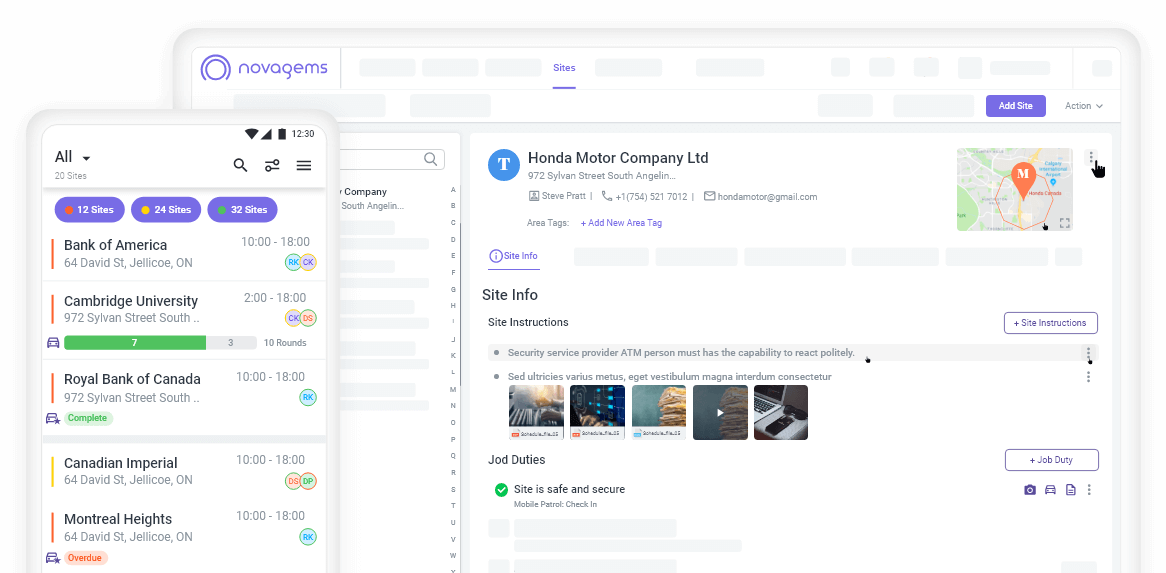
| Mobile incident reporting | Guard/staff app with photo and GPS | Novagems, Guardly, ReportExec |
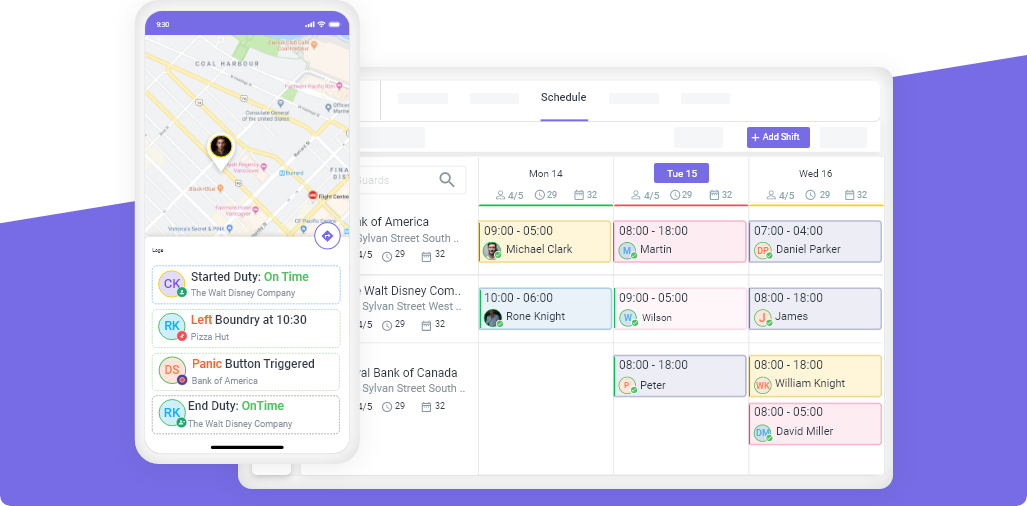
| Guard patrol verification | GPS + checkpoint scanning | Novagems GPS tracking, NFC checkpoints |
| Threat assessment software | Behavioral intervention team case management | Navigate360, Safer Schools |
| Anonymous tip line | Student/parent tip reporting | Sandy Hook Promise, TipSubmit |
| Counselor case management | Student mental health tracking | Panorama, Hanover Research |
The goal isn’t to buy everything — it’s to build a layered defense where procedures, people, and technology reinforce each other.
Legal and Regulatory Framework
K-12 and university security operate within heavy legal constraints.
K-12 Legal Considerations
- FERPA — student records privacy; security data often qualifies as educational record
- IDEA/ADA — disability rights affecting discipline and arrests
- State school safety statutes — many states mandate SRO training, active shooter drills, or threat assessment teams
- Civil rights oversight — OCR complaints over disproportionate discipline against students of color and students with disabilities
University Legal Considerations
- Clery Act — mandatory annual Security Report, daily crime log, Timely Warnings
- Title IX — sexual misconduct reporting and investigation
- FERPA — student privacy limits information sharing
- State public records laws — for public universities
Districts and universities should work with legal counsel to ensure security programs don’t create discrimination, privacy, or due process problems.
How to Evaluate School Security Vendors
If you’re contracting private security, use this evaluation framework:
Must-Haves
- Education-specific training program — not just generic guard training. Ask for the curriculum.
- Background checks meeting state school personnel standards — many states require fingerprinting and FBI checks for anyone on school grounds.
- Insurance — $2M-$5M general liability minimum; $5M+ if armed; professional liability for education settings.
- References from similar districts — at least 3 comparable schools or districts.
- Technology platform — GPS-verified patrols, digital incident reporting, supervisor dashboards. If the vendor uses a modern platform like Novagems, that’s a strong signal.
- Clear chain of command — named account manager, 24/7 supervisor availability.
- De-escalation training — specifically for youth, documented.
- Age-appropriate approach — guards should not look or act like enforcement officers in elementary schools.
Red Flags
- Guards in tactical gear or military-style uniforms at K-5
- No documented training hours for education settings
- Unable to provide current proof of state licensing
- Reluctance to share references or insurance certificates
- “All-in-one” contracts with no performance metrics
- Previous contracts with ongoing lawsuits against the company
Common School Security Mistakes
| Mistake | What Goes Wrong | Fix |
|---|---|---|
| Relying on paper visitor logs | Registered sex offenders not flagged | Digital visitor management |
| Only one locked entry point | Side doors get propped open | Sensors + regular audits |
| No behavioral threat assessment team | Warning signs missed | Formal team with training |
| Buying tech without procedures | Expensive system, no one knows how to use it | Invest equally in training |
| Skipping drills | Staff unprepared in real emergency | Quarterly staff + age-appropriate student drills |
| No parent communication plan | Rumors spread, reunification chaos | Documented parent notification playbook |
| Hiring armed guards without training standards | Liability and discharge risk | 40+ hours training, annual requalification, strict MOU |
| Over-policing students for non-criminal behavior | Disparate impact lawsuits | Clear SRO scope of work limiting arrests |
| Ignoring mental health | Threats escalate | Counselor ratio 1:250 per ASCA |
| No annual review | Program drift, outdated procedures | Annual third-party safety audit |
Getting Started: School Security Checklist
If you’re a new superintendent, principal, or campus safety director:
- Audit current state — walk every campus, identify gaps (unlocked doors, paper sign-in, missing cameras, untrained staff).
- Review incident data — last 3 years of incidents; what’s the pattern?
- Threat assessment — engage local law enforcement and a third-party safety consultant.
- Stakeholder input — students, parents, teachers, staff — what do they experience day-to-day?
- Multi-year plan — short-term fixes (visitor management, door locks), medium-term (SRO MOUs, tech rollout), long-term (facility hardening, staffing levels).
- Budget alignment — security investments should be proportional to risk, not political pressure.
- Training program — annual for all staff; quarterly for security; age-appropriate for students.
- Written policies — access control, visitor management, incident response, parent communication, use of force.
- Third-party audit — every 2-3 years, independent review.
- Continuous improvement — monthly security team reviews, annual strategic refresh.
Wrapping Up
School security is not about creating fortresses. The best-protected schools in America often look like welcoming educational spaces — with layered, unobtrusive security that doesn’t turn classrooms into prisons. The goal is learning, not lockdown.
The districts and universities getting it right share three things: they invest in procedures and people (not just technology), they maintain strong community partnerships (local police, mental health providers, parents), and they treat security as a continuous practice, not a one-time build. They also acknowledge trade-offs openly — more security isn’t always safer, and some hardening measures cause more harm than benefit.
For school administrators evaluating their current setup, the single most useful exercise is to walk the campus with a security professional and a teacher at the same time. The professional sees the vulnerabilities; the teacher sees the daily friction. A good program reconciles both perspectives.
Novagems helps security companies serving schools and universities deliver the verifiable, technology-enabled operations administrators demand — GPS-verified patrols, digital incident reporting, real-time dashboards for campus safety directors. If you’re evaluating or running school security, start a free 14-day trial to see how modern operations work.
Further Reading
- Types of Security Guard Services: A Complete Guide — pillar article covering all 12 security service categories
- Event Security Services: Complete Guide — for graduations, games, and campus events
- Residential Security Services — for university residence halls and student housing
- GPS Tracking and Geofencing — the technology behind verified campus patrols
- NFC Tags for Guard Tours — checkpoint verification for campus patrols
- Workforce Management for Security Companies — the operations platform campus security vendors should be using
See Novagems in action
Join 500+ security & cleaning companies that replaced spreadsheets with Novagems.
✓ 14-day free trial · ✓ Free onboarding · ✓ Cancel anytime