Every security company that fails in its first two years has the same story: they started with a few contracts, hired guards fast, and never figured out the numbers. The cash ran out before they could grow.
The security companies that survive and scale did one thing differently. They wrote a business plan before signing their first contract. Not a 50-page document that sits in a drawer. A working plan that answers three questions: How much does it cost to deliver each hour of security? How much do I charge? How long before I am profitable?
This guide walks you through building that plan. Every section includes what to write, what numbers to include, and where most security company owners get the math wrong. There is a downloadable template at the end.
Why Security Companies Need a Business Plan
A business plan is not a formality. It is the difference between knowing your break-even point and guessing. Here is what it does:
- Forces you to calculate real costs before you set pricing (most new companies price too low)
- Identifies cash flow gaps before they become emergencies (payroll is due every 2 weeks, clients pay in 30-60 days)
- Required by banks for any business loan or line of credit
- Shows potential partners and clients that you are serious and organized
- Creates a roadmap for growth so you are not making decisions reactively
Section 1: Executive Summary
Write this last, even though it goes first. The executive summary is a one-page overview of your entire plan. It should answer:
- What does your security company do?
- What geographic area do you serve?
- Who are your target clients?
- What services do you offer?
- What makes you different from competitors?
- What are your financial targets for year 1, 2, and 3?
Keep it under 500 words. If someone reads only this page, they should understand your business.
Section 2: Company Description and Legal Structure
| Item | What to Include |
|---|---|
| Company name | Legal name and DBA (if different) |
| Legal structure | LLC, Corporation, or Sole Proprietorship (LLC is most common for security companies) |
| State of incorporation | Where you are registered |
| Licenses | State security company license number and status |
| Insurance | General liability, workers compensation, professional liability |
| Location | Office address and service area |
| Founded | Date or planned launch date |
| Ownership | Names and ownership percentages of all owners |
Tip: In most states, the security company itself must hold a company license (separate from individual guard cards). In California, this is a Private Patrol Operator (PPO) license through BSIS, which requires the qualifying manager to have 4,000 hours of security experience.
Section 3: Market Analysis
This section proves there is demand for your services and that you understand the competitive landscape.
Market Size
The US security services market is valued at approximately $132 billion (2024) and is growing at 3.8% annually. Security guard services represent the largest segment.
Target Market
Define your target clients specifically:
| Client Type | Typical Contract Value | Competition Level |
|---|---|---|
| Commercial office buildings | $3,000-$15,000/month | High |
| Retail centers and malls | $5,000-$25,000/month | High |
| Construction sites | $2,000-$8,000/month | Medium |
| Warehouse and logistics | $3,000-$12,000/month | Medium |
| Residential communities (HOAs) | $2,000-$6,000/month | Low-Medium |
| Event security | $500-$5,000/event | Medium |
| Government contracts | $10,000-$100,000+/month | High (bonding required) |
Competitive Analysis
List your top 3-5 local competitors and document:
- Their services and pricing (if available)
- Their strengths and weaknesses
- How your company will differentiate
Most new security companies differentiate on one of these: price (risky), technology (smart), specialization (safest), or client service (effective).
SWOT Analysis for Your Security Company
Every business plan should include a SWOT analysis. Fill this in honestly. Lenders look for self-awareness, not perfection.
| Helpful | Harmful | |
|---|---|---|
| Internal | Strengths | Weaknesses |
| What do you do better than competitors? (e.g., technology, response time, niche expertise, local relationships) | What are you lacking? (e.g., limited capital, no track record, small team, no armed capability) | |
| External | Opportunities | Threats |
| What market conditions work in your favor? (e.g., growing local development, competitor closing, new regulations requiring security) | What could hurt your business? (e.g., price wars, labor shortage, economic downturn reducing client budgets) |
Example SWOT for a new 10-guard security company:
| Helpful | Harmful | |
|---|---|---|
| Internal | Modern technology (GPS tracking, digital reporting), owner has 15 years industry experience, low overhead (home office) | No existing client base, limited capital ($25K), only unarmed services initially |
| External | 3 new commercial developments breaking ground in service area, largest local competitor has poor Google reviews | Minimum wage increase in state will raise guard pay costs, 2 national companies expanding locally |
Section 4: Services and Pricing
Services Offered
List each service with a brief description and pricing:
| Service | Description | Typical Bill Rate |
|---|---|---|
| Static guard (unarmed) | Fixed post security at client site | $25-$35/hr |
| Static guard (armed) | Armed fixed post security | $35-$55/hr |
| Mobile patrol | Vehicle-based patrol covering multiple sites | $30-$45/hr |
| Event security | Temporary security for events | $30-$50/hr |
| Fire watch | Temporary fire safety monitoring | $25-$40/hr |
| Executive protection | Close protection for individuals | $75-$150/hr |
How to Calculate Your Bill Rate
This is where most new security companies make their biggest mistake. They look at what competitors charge and match it, without calculating whether that rate actually covers their costs.
Use this formula:
Bill Rate = Guard Pay + Payroll Burden + Overhead + Profit Margin
Example calculation for an unarmed guard:
| Cost Component | Amount | How Calculated |
|---|---|---|
| Guard hourly pay | $18.00 | Market rate for your area |
| Payroll taxes (FICA, FUTA, SUTA) | $1.98 | ~11% of pay |
| Workers compensation insurance | $2.70 | ~15% of pay (varies by state) |
| General liability insurance | $0.90 | ~5% of pay |
| Uniforms and equipment | $0.50 | Amortized per hour |
| Guard management software | $0.35 | ~$10/guard/month / hours worked |
| Admin overhead (office, phone, etc.) | $1.00 | Fixed costs / total billable hours |
| Total cost per hour | $25.43 | |
| Profit margin (15%) | $3.82 | |
| Bill rate to client | $29.25 | Round to $29.50 or $30/hr |
If you charge less than $25.43/hr in this example, you lose money on every hour. This is why calculating your actual cost per hour is non-negotiable.
Section 5: Marketing and Sales Strategy
How to Get Your First Contracts
| Strategy | Cost | Timeline | Best For |
|---|---|---|---|
| Direct outreach to property managers | $0 | 1-3 months | First 3-5 contracts |
| BOMA/IFMA networking events | $200-$500/event | 2-6 months | Commercial properties |
| Online presence (website + Google Business) | $500-$2,000 | 1-3 months | Local visibility |
| Bid on government contracts (SAM.gov) | $0-$500 | 3-12 months | Larger contracts |
| Referrals from existing clients | $0 | Ongoing | Best source after first year |
| Google Ads for local searches | $500-$2,000/month | Immediate | Leads when you need them |
Client Retention Strategy
Acquiring a new client costs 5-10x more than keeping an existing one. Plan for:
- Monthly client reports showing coverage, incidents, and guard performance
- Quarterly review meetings with each client
- Technology that gives clients real-time visibility (client portal with Novagems)
Section 6: Operations Plan
Scheduling and Workforce Management
This is the operational core of any security company. Your plan should address:
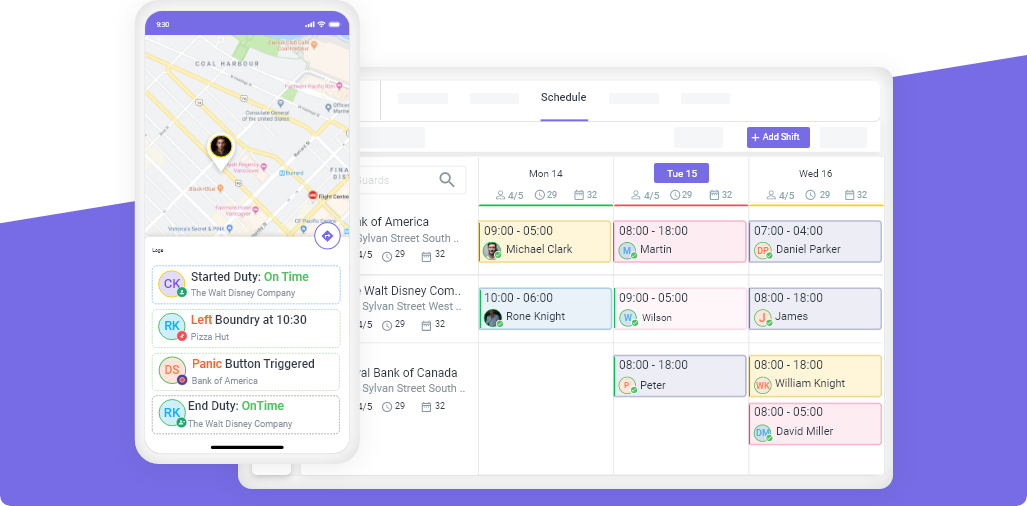
- How you will build and manage guard schedules across multiple sites
- How you will handle last-minute callouts and no-shows
- How you will track guard locations and verify they are on site
- How you will collect accurate timesheets for payroll
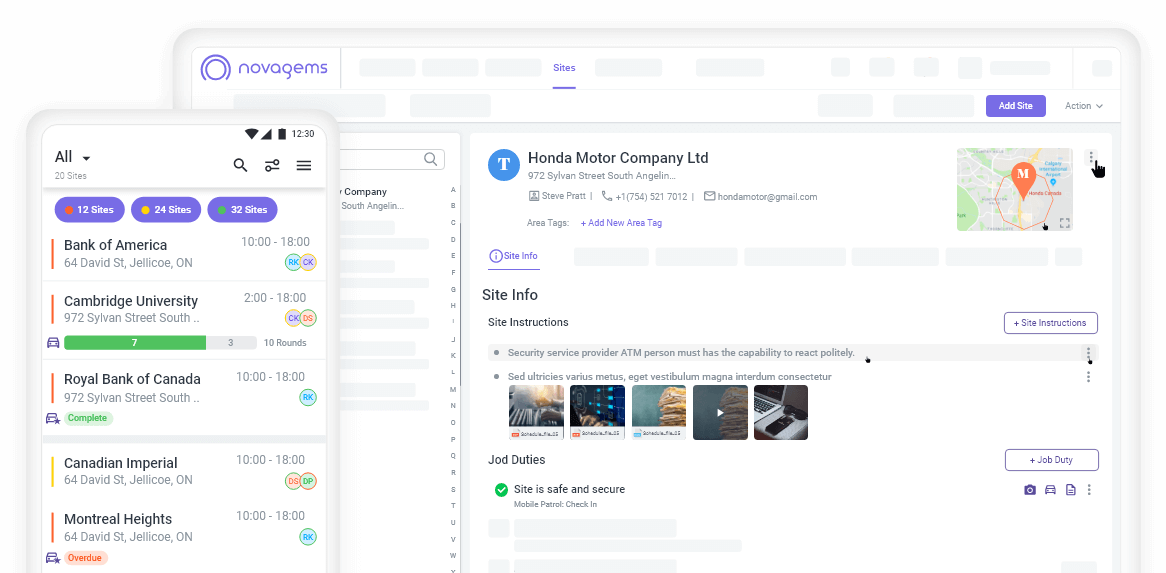
- What software you will use to manage operations
Manual methods (spreadsheets, phone calls, paper timesheets) work for the first 5-10 guards. Beyond that, you need scheduling software with GPS tracking, checkpoint tours, and automated timesheets.
Budget $6-$15 per guard per month for workforce management software. This replaces hours of manual scheduling, eliminates payroll disputes, and gives clients the professional reports they expect. Novagems offers a 14-day free trial to test before committing.
Technology Stack
| System | Purpose | Monthly Cost |
|---|---|---|
| Guard management software | Scheduling, GPS, timesheets, reporting | $6-$15/guard |
| Accounting software (QuickBooks) | Invoicing, payroll, expenses | $30-$80 |
| Communication (Slack or Teams) | Internal team chat | $0-$7/user |
| CRM (HubSpot free) | Client and lead tracking | $0 |
| Website hosting | Online presence | $20-$50 |
Section 7: Management Team
Lenders and partners want to know who is running the company. Include:
- Owner/CEO: Background, security industry experience, qualifications
- Operations Manager: Scheduling, guard management, client relations
- Qualifying Manager (required in most states): Person who meets the state’s experience requirements for the company license
If you are starting alone, that is fine. Document your plan for hiring as you grow. Most security companies hire their first operations manager at 20-30 guards.
Section 8: Financial Projections
This is the most important section for lenders and the most useful section for you.
Startup Cost Breakdown
| Expense | Low Estimate | High Estimate |
|---|---|---|
| State company license | $500 | $5,000 |
| General liability insurance (annual) | $3,000 | $8,000 |
| Workers compensation insurance (deposit) | $2,000 | $5,000 |
| Guard training and certification | $1,000 | $3,000 |
| Uniforms and equipment (first 10 guards) | $1,500 | $4,000 |
| Office setup (or home office) | $500 | $3,000 |
| Website and marketing | $1,000 | $5,000 |
| Guard management software (first year) | $500 | $2,000 |
| Working capital (2-3 months payroll) | $10,000 | $30,000 |
| Legal and accounting setup | $1,000 | $3,000 |
| Total startup costs | $21,000 | $68,000 |
Revenue Projections (3-Year)
| Metric | Year 1 | Year 2 | Year 3 |
|---|---|---|---|
| Number of guards | 10 | 25 | 50 |
| Average bill rate | $29/hr | $30/hr | $31/hr |
| Utilization rate | 75% | 80% | 85% |
| Annual revenue | $452K | $1.25M | $2.74M |
| Gross margin | 22% | 25% | 28% |
| Net profit | $36K | $125K | $328K |
Key assumptions:
- Guards work an average of 40 hours/week
- Utilization rate accounts for gaps between contracts, training time, and unfilled shifts
- Margin improves with scale due to fixed cost leverage (admin, software, insurance)
Cash Flow Warning
The biggest financial risk for new security companies is the payroll-to-payment gap. You pay guards every 2 weeks. Clients pay invoices in 30-60 days. That means you need 6-8 weeks of payroll cash on hand before your first client payment arrives.
Plan for this. Either save enough working capital, secure a line of credit, or negotiate Net-15 payment terms with your first clients.
Sample Monthly Profit & Loss Statement (20 Guards)
This is what a healthy security company P&L looks like after 12 months of operation with 20 guards:
| Line Item | Monthly Amount |
|---|---|
| Revenue | |
| Guard services billed (20 guards x 160 hrs x $30/hr) | $96,000 |
| Total Revenue | $96,000 |
| Cost of Services | |
| Guard wages (20 x 160 hrs x $18/hr) | $57,600 |
| Payroll taxes (11% of wages) | $6,336 |
| Workers compensation (15% of wages) | $8,640 |
| Uniforms and equipment | $400 |
| Total Cost of Services | $72,976 |
| Gross Profit | $23,024 (24%) |
| Operating Expenses | |
| General liability insurance | $500 |
| Office rent / home office | $800 |
| Guard management software | $200 |
| Phone and internet | $150 |
| Vehicle costs (mobile patrol) | $600 |
| Marketing and advertising | $500 |
| Accounting and legal | $300 |
| Owner salary | $5,000 |
| Total Operating Expenses | $8,050 |
| Net Profit | $14,974 (15.6%) |
Key takeaway: At 20 guards billing $30/hr, you generate roughly $15K/month in net profit after paying yourself $5K. Margins improve with scale because operating expenses stay relatively fixed as you add guards.
Contract Pricing Examples by Client Type
Different clients require different pricing. Here are real-world examples:
| Client Type | # Guards | Shifts | Bill Rate | Monthly Contract Value | Your Monthly Profit (est.) |
|---|---|---|---|---|---|
| Small office building | 1 | Mon-Fri, 8hr day shift | $28/hr | $4,480 | $800 |
| Retail center | 2 | 7 days, day + swing shifts | $30/hr | $14,880 | $2,900 |
| Construction site | 1 | 7 days, 24hr coverage (3 shifts) | $27/hr | $18,144 | $2,700 |
| Warehouse complex | 3 | Mon-Fri, day + night shifts | $29/hr | $13,920 | $2,500 |
| Corporate campus | 4 | 7 days, 24hr coverage | $32/hr | $42,880 | $8,600 |
| HOA / Residential | 1 | Fri-Sun night patrol only | $35/hr | $4,200 | $1,050 |
Pricing tips:
- Armed guards command $10-$20/hr more than unarmed
- Night and weekend shifts should be billed 10-15% higher
- Long-term contracts (12+ months) can offer 5% discount to lock in revenue
- Never price below your cost-per-hour calculation — it is better to lose a bid than lose money on every hour
Section 9: Download the Template
We have created a complete security company business plan template that you can customize for your operation. It includes all sections above with fill-in prompts, financial projection spreadsheet formulas, and example text.
Next Steps After Writing Your Plan
- Get your state company license — requirements vary by state. See our state-by-state guide →
- Set up insurance — general liability and workers compensation at minimum
- Choose your technology — start your free trial with Novagems to handle scheduling, GPS tracking, and client reporting from day one
- Start prospecting — reach out to property managers in your area with your plan and pricing
- Hire your first guards — start with 3-5 reliable guards and grow from there
Related Resources
See Novagems in action
Join 500+ security & cleaning companies that replaced spreadsheets with Novagems.
✓ 14-day free trial · ✓ Free onboarding · ✓ Cancel anytime