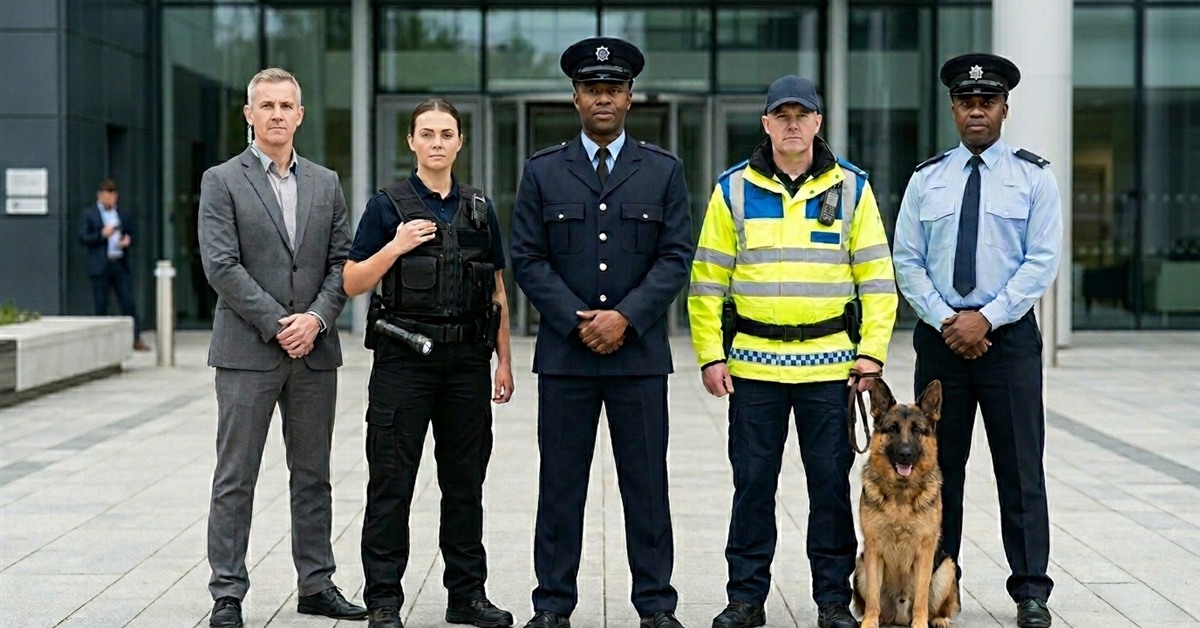
Security guard services are private protection services that businesses and property owners hire to prevent crime, control access, respond to incidents, and provide documented proof of coverage. The main types of security guard services are: static/stationed guards, mobile patrol, armed and unarmed guards, and industry-specific specialists (bank, event, hospital, retail, warehouse, construction, school, residential, and executive protection). Choosing the right type depends on your risk profile, budget, and operational needs — this guide walks through every option, pricing, and how to decide.
The US private security industry generates over $50 billion annually and employs more than 1.1 million guards (Bureau of Labor Statistics, 2024). Canadian private security is a $5 billion industry with ~140,000 active guards. Yet most property managers, business owners, and event planners hiring security don’t fully understand what they’re buying — which leads to under-paying for inadequate coverage or over-paying for unnecessary armament.
This guide fixes that. By the end, you’ll know exactly which type of security service fits your situation, what it should cost, and what questions to ask when evaluating vendors.
What Are Security Guard Services?
Security guard services are contracted or in-house personnel who perform four core functions at a protected location:
- Deterrence — visible presence that discourages criminal behavior
- Access control — verifying identity of people entering a property
- Observation and reporting — monitoring the site for threats, safety issues, or policy violations
- Response — addressing incidents, coordinating with police/emergency services, documenting what happened
Every security service — from an armed bank guard to an unarmed apartment doorman — performs some mix of these four functions. The differences come down to where the guard is (deployment model), how they’re equipped (armament), and what they’re trained for (industry specialization).
The Security Services Market in 2026
| Metric | US | Canada |
|---|---|---|
| Market size | $50+ billion | ~$5 billion |
| Active guards | ~1.1 million | ~140,000 |
| Annual growth rate | 4-6% | 3-5% |
| Top verticals | Commercial property, healthcare, events | Commercial property, retail, events |
| Dominant model | Contract (outsourced) — 75%+ | Contract — 70%+ |
Most businesses hire contract security firms rather than managing guards in-house. Contract security shifts the operational burden (licensing, insurance, scheduling, payroll, compliance) to a specialist firm, while the client pays a predictable hourly rate.
Types of Security by Deployment Model
How a guard is physically stationed determines the operational model. The four main deployment types each solve different problems.
Static / Stationed Guards
What they do: Remain at a fixed post (lobby, entrance, gate, reception desk) for their entire shift.
Best for:
- 24/7 coverage of a single site
- High-traffic access control (office buildings, hospitals, hotels)
- Visible deterrence at critical locations
- Client-facing roles (greeting visitors, signing in guests)
Cost range: $22-$35/hour (unarmed US), $30-$50/hour (armed US)
Pros:
- Consistent presence builds rapport with site users
- Immediate response to incidents at that location
- Strong deterrent value
- Easier to train on site-specific procedures
Cons:
- Only covers one location
- Guard fatigue on long shifts
- Higher hourly cost than mobile patrol for equivalent coverage
- Single point of failure if guard is sick or no-shows
Mobile Patrol Guards
What they do: Drive (or walk) between multiple sites, typically checking each location every 1-3 hours.
Best for:
- Multiple sites that don’t need constant presence
- Budget-conscious coverage (1 guard covers 5-10 sites)
- After-hours verification (warehouses, construction sites, parking lots)
- Alarm response and dispatch
Cost range: $25-$40/hour (varies by route length, number of sites)
Pros:
- Cost-effective for multi-site operations
- Unpredictable arrival deters opportunistic crime
- Covers ground a static guard can’t
- Good fit for secondary/low-risk sites
Cons:
- Presence is intermittent — not continuous
- Response time is longer than static (mobile unit may be 10-20 min away)
- Requires vehicles, insurance, routing planning
- Less visible deterrent effect
Mobile patrol is one of the fastest-growing service categories in 2026 as property managers look for cost-effective coverage.
Hybrid (Static + Mobile)
What they do: Combine static guards at primary posts with mobile patrol covering secondary areas or after-hours.
Best for:
- Commercial properties with multiple buildings
- Large campuses (corporate, industrial, hospital)
- 24/7 operations where not every area needs constant presence
Cost range: $25-$40/hour average (mix of static and mobile rates)
This is the most common model for medium-to-large commercial clients. For example: a corporate campus might have static guards at the main lobby and loading dock, with a mobile patrol unit making hourly rounds of parking lots and perimeter fence.
Virtual / Remote Monitoring
What they do: Monitor live camera feeds from an off-site security operations center (SOC), dispatch in-person guards or police only when an incident occurs.
Best for:
- Budget-sensitive clients who still want 24/7 surveillance
- Low-traffic sites (self-storage, small businesses, construction yards)
- Supplementing existing on-site guards with extra eyes after hours
Cost range: $5-$15 per hour (dramatically cheaper than in-person guards)
Virtual monitoring is growing fast as camera AI improves. It’s not a full replacement for physical guards at high-risk sites, but it’s an effective supplement or cost-saver at low-risk ones.
Types of Security by Armament
Unarmed Security Guards
What they do: Provide observation, access control, deterrence, and reporting — without carrying a firearm. May carry non-lethal tools (handcuffs, batons, pepper spray) depending on jurisdiction and training.
Best for:
- Office buildings, retail centers, residential communities
- Low-to-moderate risk sites
- Customer-facing roles where a uniformed but non-threatening presence is ideal
- Construction sites, warehouses
Cost range: $22-$35/hour
Who needs them: ~80% of US private security contracts use unarmed guards. For most commercial properties, unarmed is the right choice.
Armed Security Guards
What they do: Carry a firearm on duty and are licensed/trained to use lethal force when justified.
Best for:
- Banks and financial institutions
- Jewelry stores, high-value retail
- Cash-in-transit operations (armored car)
- Healthcare facilities with specific threat profiles
- Government and sensitive facilities
- Sites in high-crime areas with documented threats
Cost range: $30-$50/hour
Requirements: Armed guards need additional state licensing (e.g., California Guard Card + Firearm Permit; Texas Level III Commissioned). Many states also require psychological evaluation and annual firearms qualification.
When to Choose Each
| Risk Factor | Unarmed | Armed |
|---|---|---|
| Low-value assets (office equipment, retail goods) | ✓ | — |
| Medium-value (jewelry, electronics) | ✓ (daytime) | ✓ (overnight) |
| High-value cash on-site | — | ✓ |
| History of violent crime at/near site | — | ✓ |
| Client-facing, customer service role | ✓ | — |
| Deterrence only (no active threat) | ✓ | — |
| Regulatory requirement (bank, armored transport) | — | ✓ |
Rule of thumb: Start unarmed. Add armed coverage only when a documented threat analysis shows it’s justified. Armed guards cost 30-50% more, carry significantly higher liability for the client, and can escalate incidents that unarmed de-escalation would resolve.
Types of Security by Industry
Different industries have different threats, regulations, and client expectations. These are the 9 main vertical security specializations — each has its own complete guide.
1. Bank & Financial Services Security
Banks face unique threats (robbery, fraud, cash handling) and operate under federal regulations (Bank Protection Act of 1968). Guards are typically armed, require specific training on banking procedures, and must pass enhanced background checks.
Typical setup: 1-2 armed static guards per branch during business hours. ATM security and cash transport are separate specialties.
2. Event Security
From corporate conferences to concerts to political rallies, event security covers crowd management, ticket/credential checks, perimeter control, and emergency response. Event security is temporary (per-event or seasonal) and requires rapid team deployment.
Typical setup: Tiered security — lead security director, zone supervisors, general event staff. Crowd-to-guard ratios typically 250:1 for low-risk events, 50:1 for high-risk.
Cost: $35-$75+/hour depending on event type and risk level.
3. Hospital & Healthcare Security
Hospitals face workplace violence, patient aggression (dementia patients, psychiatric holds, overdose patients), and visitor conflicts. Healthcare security requires de-escalation training, HIPAA awareness, and (increasingly) IAHSS certification.
Typical setup: Static guards at ER entrances, mobile patrol in parking structures, dedicated behavioral health unit coverage.
4. Retail Security & Loss Prevention
Retail security combines visible uniformed guards (deterrence) with plainclothes loss prevention officers (detection). Focus is shoplifting, organized retail crime (ORC), employee theft, and customer safety.
Typical setup: Uniformed guards at entrances during peak hours; plainclothes LP during all hours; dedicated coverage for holiday seasons.
5. Warehouse & Industrial Security
Warehouses protect high-value inventory against cargo theft, “inside job” employee theft, and trailer break-ins. Industrial facilities (chemical plants, oil & gas) add safety compliance and perimeter security.
Typical setup: 24/7 static guards at main gates; mobile patrol for large perimeters; access control and truck driver verification.
6. Construction Site Security
Construction sites are extremely high-theft environments (copper, tools, equipment, materials). Security is typically overnight and weekends when sites are unoccupied. Mobile patrol dominates this vertical.
Typical setup: Mobile patrol 3-4 times per night, plus remote camera monitoring. Static overnight guard for larger projects.
7. School & Campus Security
School security ranges from unarmed visitor screening at elementary schools to armed School Resource Officers (SROs) at high schools, to full-scale campus police at universities. Active shooter response is the primary training focus.
Typical setup: Varies dramatically. K-12 private security often supplements or replaces SROs; colleges may have full-scale campus police departments.
8. Residential & Gated Community Security
Residential security serves gated communities, luxury apartment buildings, and HOA-managed neighborhoods. Focus is access control at gates, resident relations, and overnight patrol.
Typical setup: 24/7 static guard at main gate; roving mobile patrol of the community; visitor verification protocols.
9. Executive Protection
EP (also called close protection or personal security detail) protects high-net-worth individuals, executives, celebrities, and their families from targeted threats — kidnapping, stalking, assault.
Typical setup: Solo protection officer for low-risk principals; 2-4 person teams for high-risk; advance teams for travel.
Cost: $75-$150+/hour per officer; full teams can exceed $10,000/day.
How to Choose the Right Security Service
Follow this 5-step decision framework.
Step 1: Conduct a Risk Assessment
Document:
- What you’re protecting (assets, people, data, reputation)
- Known threats (past incidents, local crime rates, industry-specific threats)
- Vulnerabilities (unsecured entry points, lighting gaps, personnel turnover)
- Regulatory requirements (bank protection act, HIPAA, PCI-DSS, state/local laws)
This assessment drives every other decision.
Step 2: Match Risk to Service Type
| If your priority is… | Service type |
|---|---|
| 24/7 coverage of a single site | Static guards |
| Cost-effective multi-site coverage | Mobile patrol |
| Access control for office building | Unarmed static |
| Cash handling, high-value assets | Armed static |
| After-hours construction/warehouse | Mobile patrol + cameras |
| Event security | Specialized event security firm |
| Hospital/healthcare | IAHSS-certified guards |
| Gated community | Static gate + roving patrol |
| Executive/C-suite protection | EP specialist firm |
Step 3: Shortlist 3 Vendors
Look for:
- State license (current and in good standing — verify with state BSIS/DPS/DOS)
- General liability insurance ($1M-$2M minimum; $5M+ for high-risk work)
- Workers’ comp coverage
- Years in business (3+ preferred, 1+ minimum)
- References in your industry vertical
- Technology (GPS tracking, client portal, digital incident reporting)
Step 4: Request Proposals
A professional proposal includes:
- Clear scope of work (number of guards, hours, posts, duties)
- Transparent pricing breakdown
- Staff qualifications and training summary
- Insurance certificate
- Technology and reporting capabilities
- Named project manager or account supervisor
- References from similar clients
Avoid vendors that won’t provide this.
Step 5: Compare and Decide
Don’t choose on price alone. The cheapest bid often means:
- Underpaying guards (leads to turnover, poor service)
- No technology (you’ll have no visibility into service)
- Cutting corners on training
- Insurance gaps
Choose the vendor who combines adequate pricing (mid-range, not lowest), professional operations (technology, reporting), and cultural fit (communication style, responsiveness).
Security Guard Cost & Pricing
Typical US Billing Rates (2026)
| Service Type | Hourly Rate | Annual Cost (40 hrs/week) |
|---|---|---|
| Unarmed static guard | $22-$35 | $46,000-$73,000 |
| Armed static guard | $30-$50 | $62,000-$104,000 |
| Mobile patrol (1 unit, full time) | $25-$40 | $52,000-$83,000 |
| Event security | $35-$75+ | Per-event billing |
| Executive protection | $75-$150+ | $156,000-$312,000+ |
| Hospital security (unarmed) | $25-$38 | $52,000-$79,000 |
| Construction site (overnight) | $25-$35 | $52,000-$73,000 |
| Virtual monitoring | $5-$15 | $10,000-$31,000 |
What Drives Cost
- Location — NYC/LA/SF are 20-40% above national average; rural areas 10-20% below
- Shift type — overnight adds 10-15%; weekends/holidays add 25-50%
- Training level — specialized training (healthcare, armed, executive) adds 20-40%
- Insurance requirements — high-risk sites may require higher liability coverage, passed to client
- Contract length — 3+ year contracts typically 10-15% cheaper than month-to-month
The “Too Cheap” Red Flag
If a vendor bids 25%+ below market rate, assume one of these:
- They’re paying guards below market (turnover will be 200%+)
- They’re skipping training
- They’re under-insured
- They plan to increase rates after year 1
- They’re cutting operational corners
Pricing should reflect labor cost + 30% burden (taxes, insurance, workers comp) + 10-20% overhead + 10-15% margin. Rates below that math aren’t sustainable.
For details on how security companies price contracts, see our guide on how to price security guard contracts.
Technology in Modern Security Services
A professional security service in 2026 should use:
| Technology | What It Does | Why It Matters |
|---|---|---|
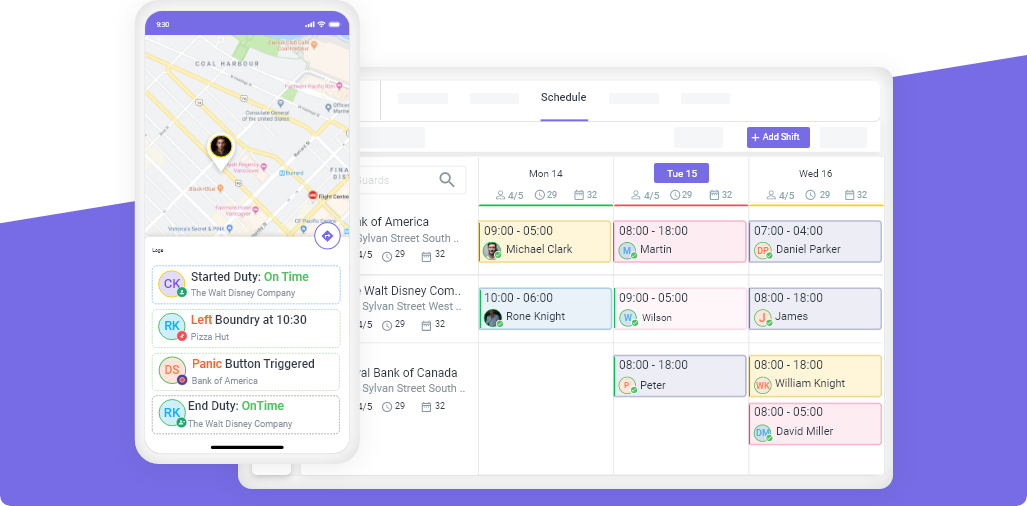
| GPS-tracked mobile app | Records guard location every 30-60 seconds | Proves guards are on-site — no more blind trust |
| Geofenced clock-in | Blocks clock-in from outside the site boundary | Eliminates buddy punching and time fraud |
| NFC checkpoint scanning | Guards tap phone on tags at patrol points | Tamper-proof proof of every patrol stop |
| Digital incident reports | Photos, GPS, timestamps attached automatically | Professional documentation, client-ready reports |
| Client portal | Clients see patrol data, incidents, reports | Transparency builds trust and retention |
| Scheduling software | Prevents overtime, ensures coverage | Fewer no-shows, better margins |
| Security dispatch software | Routes calls to nearest guard in real-time | Faster response, better accountability |
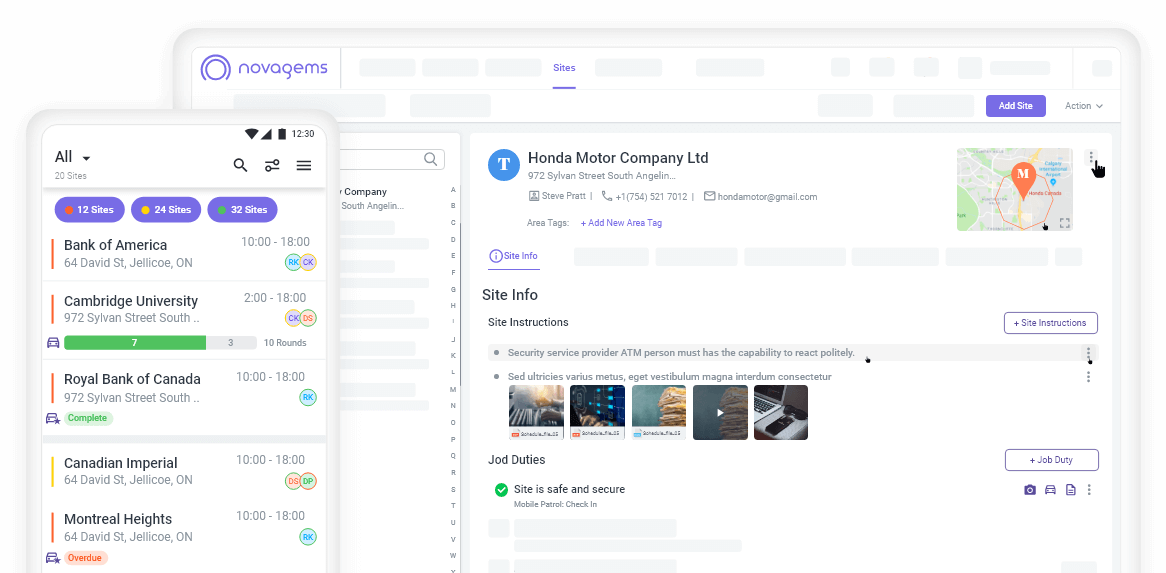
If a security company is still using paper logs and phone check-ins, they’re operating 10 years behind industry standard. Ask to see their technology during the sales process. Platforms like Novagems give clients GPS-verified proof of every patrol, automated incident reports, and real-time visibility into their security operation.
Frequently Asked Questions
Who hires private security services?
The biggest buyers of private security are commercial property owners (office buildings, retail centers), healthcare systems, universities, banks, event venues and organizers, construction general contractors, residential/HOA managers, and government agencies. Together these represent about 85% of the $50B+ US security market.
Is private security licensed?
Yes. Every US state and Canadian province licenses private security companies and individual guards. Company licenses come from state agencies (California BSIS, Texas DPS, Florida FDACS, NY DOS, etc.). Individual guards hold state-issued guard cards (names vary: BSIS Guard Card in CA, DOS Registration in NY). Armed guards require additional firearm permits.
Can private security make arrests?
Generally, private security guards have the same arrest authority as any private citizen — they can make a “citizen’s arrest” when a crime is committed in their presence. They cannot use police-level detention authority. Specific rules vary by state. Most security contracts discourage arrests in favor of observe-and-report procedures that minimize client liability.
How long does it take to hire a security company?
For commercial contracts, typical timeline is 2-6 weeks from first contact to signed agreement. For government RFPs, 30-90 days. Emergency coverage (event security, urgent patrol) can often be arranged in 24-72 hours at a premium rate.
Should I use in-house or contracted security?
For most businesses, contracted is more cost-effective. In-house security means you handle licensing, training, insurance, payroll, compliance, and replacement guards yourself — a full-time operational burden. Contracted security shifts all of that to a specialist. In-house makes sense only when you have 50+ guards, specialized requirements, or regulatory reasons (some government/financial contracts require employee-only coverage).
Getting Started
If you’re evaluating security guard services for your property or business:
- Complete the 5-step decision framework above to understand what type of service you need
- Shortlist 3 local vendors with verified licensing and insurance
- Request proposals and compare them on scope, pricing, references, and technology
- Start small — a 3-month initial contract lets you evaluate the vendor before committing long-term
- Measure the results — response times, incident quality, client communication, and technology usage
If you run a security company and want to offer more professional service with GPS-verified proof of patrol, digital reporting, and client portals, start a free 14-day trial with Novagems and see how modern security operations work.
See Novagems in action
Join 500+ security & cleaning companies that replaced spreadsheets with Novagems.
✓ 14-day free trial · ✓ Free onboarding · ✓ Cancel anytime